Cressida Grainger started her entrepreneurial career at the age of 22, running a small antiques business. Whilst on a visit to Glasgow market, she discovered lava lamps and bought some to sell on her Camden market stall. The 1960s lamps, which mix oil and water to create psychedelic patterns, were an instant success so she tracked down the inventor, Edward Craven, and eventually bought the then loss-making business from him.
In 1989, Mathmos was born. The firm started to market the lamps to a new set of fashion conscious consumers eager to buy ‘retro chic’ products. The marketing paid off and since then, Mathmos has enjoyed spectacular success, achieving £18 million of sales in 1999.
However, the business has recently run into some difficulties. Following the success of the lava lamps, competitors from the Far East have realised the potential of the products and the market is now being flooded with imitation lamps that are sold at prices that Mathmos would struggle to make the item for. This problem is increased by retailers who stock the cheaper, imported goods alongside the Mathmos originals. In effect, the Mathmos name is advertising other companies’ products.
Grainger is determined to fight back, though. With the name Mathmos linked to high quality products and first-rate after sales service, she believes that her business can be expanded in order to win back market share. Two strategies are being considered.
Option One: Diversification into other product areas, such as gifts and fashion accessories.
Option Two: Extend Mathmos’ unique position as leaders in innovative domestic lighting through the development of new lighting products.
Ultimately, Grainger knows that Mathmos must maintain its innovative edge in order to remain successful in the market place.
(Adapted from Sarah Gracie, The Sunday Times, April 9 2000)
Questions
1. Explain why Mathmos lava lamps were initially so successful.
Probably the main reason for this lava lamps to be successful is that a great advertising company was made- in order to make the consumer consider this product not as an old, out-of-fashion and useless thing, but as a 'retro-chic' product. So it was extremely fashionable. And, as we learned from the article, the right marketing strategy also played a great role in expanding the demand for the product.
2. Recently, Mathmos has begun to experience some difficulties. Analyse the key causes of these problems.
As the new firms entered the market, providing the same products for the lower price, the demand for the original product fell down. People didn't understand the difference between the original lamp and the imitation, or probably, didn't consider this difference worth overpaying for. People had already known all the benefits of the product and the target audience had been already formed - so there was no need for new firms to make a great advertising company. Therefore, they reduced their production costs, which allowed to make the product cheaper - - -> more attractive for consumers.
3. Explain how the use of market segmentation could help Mathmos to market its products
effectively.
Market segmentation is the process of classifying a market into distinct subsets (segments) that behave in similar ways or have similar needs. (wikipedia)
There are 4 main factors, using which the market can be segmented: demographical, geographical, behaviour and psyhographic bases.
So the whole lava lamp market wil be divided into several segments according to consumers purchasing abilities, product knowledge, usage and so on.
Therefore, market segmentation will increase market opportunities, as the consumer's needs will be recognised and satisfied more efficiently, that means, Mathmos will market his products more efficiently.
4. Evaluate the advantages and disadvantages of the possible options for development.
Firstly, option one seems to be a good idea, as if the lava lamp production diverses into other product areas, its target audience changes, so the new target audience might be wider and more willing to buy the product. In addition, it's clear that the lava lamp will be new to such product areas as gifts and fashion accessories, therefore, it should attract the consumers by its newness and exceptioness for this area of the market
Disadvantage may consist in this product being unappropriate for this area of the market, for exmaple, if nobody considers lava lamps as gifts.
Option two seems to me more profitable: it will make Mathmos a monopoly, which will allow to set the suitable prices for the new lamp products and, therefore, increase allocative efficiency and profit.
But the problem is - if there won't even be enough quantity of demand for the new types of lamp to cover all production costs? That is the thing that deals with market research- in this case, i guess, it is unavoidable .
Saturday, 25 October 2008

Friday, 24 October 2008


Wednesday, 22 October 2008
The Prisoner's Dilemma
The best way to understand the Prisoner's Dilemma is to set 2 examples.
A classic example of the Prisoner's Dilemma
Two suspects are arrested by the police. The police have insufficient evidence for a conviction, and, having separated both prisoners, visit each of them to offer the same deal.
If one testifies ("defects") for the prosecution against the other and the other remains silent, the betrayer goes free and the silent accomplice receives the full 10-year sentence.
If both remain silent, both prisoners are sentenced to only six months in jail for a minor charge.
If each betrays the other, each receives a five-year sentence. Each prisoner must choose to betray the other or to remain silent. Each one is assured that the other would not know about the betrayal before the end of the investigation. How should the prisoners act?

Economics application of the Prisoner's Dilemma.
Consider two firms, say Coca-Cola and Pepsi, selling similar products. Each must decide on a pricing strategy.
They best exploit their joint market power when both charge a high price; each makes a profit of ten million dollars per month. If one sets a competitive low price, it wins a lot of customers away from the rival.
Suppose its profit rises to twelve million dollars, and that of the rival falls to seven million. If both set low prices, the profit of each is nine million dollars.
Here, the low-price strategy is akin to the prisoner’s confession, and the high-price akin to keeping silent. Call the former cheating, and the latter cooperation. Then cheating is each firm’s dominant strategy, but the result when both “cheat” is worse for each than that of both cooperating.
sources:
1
2
A classic example of the Prisoner's Dilemma
Two suspects are arrested by the police. The police have insufficient evidence for a conviction, and, having separated both prisoners, visit each of them to offer the same deal.
If one testifies ("defects") for the prosecution against the other and the other remains silent, the betrayer goes free and the silent accomplice receives the full 10-year sentence.
If both remain silent, both prisoners are sentenced to only six months in jail for a minor charge.
If each betrays the other, each receives a five-year sentence. Each prisoner must choose to betray the other or to remain silent. Each one is assured that the other would not know about the betrayal before the end of the investigation. How should the prisoners act?

Economics application of the Prisoner's Dilemma.
Consider two firms, say Coca-Cola and Pepsi, selling similar products. Each must decide on a pricing strategy.
They best exploit their joint market power when both charge a high price; each makes a profit of ten million dollars per month. If one sets a competitive low price, it wins a lot of customers away from the rival.
Suppose its profit rises to twelve million dollars, and that of the rival falls to seven million. If both set low prices, the profit of each is nine million dollars.
Here, the low-price strategy is akin to the prisoner’s confession, and the high-price akin to keeping silent. Call the former cheating, and the latter cooperation. Then cheating is each firm’s dominant strategy, but the result when both “cheat” is worse for each than that of both cooperating.
sources:
1
2
multiple choice questions
Market Failure and Government Failure.
1. A farmer tips chemical waste into a river because he can do so at no cost to itself is an example of a positive externality.
a) True
b) False
2. People may not know what is in their own best interests and thus may under-consume certain goods or services such as education or health care.
a) True
b) False
3. Government failure cannot happen if the government has the support of consumers and producers when it decides on it's policies.
a) True
b) False
4. The list below shows the estimated costs and benefits of building a new factory
Private costs 90,000 pounds
External costs 30,000 pounds
Private benefits 75,000 pounds
External benefits 25,000 pounds
From the data it can be concluded that
a) Social costs exceed social benefits
b) Social benefits exceed social costs
c) The factory should be built
d) The social costs equal 30,000 pounds
5. Which one of the following is a characteristic of a merit good?
a) Once the good has been supplied to one consumer, there is no extra cost in supplying it to others
b) It is always provided free of charge to low-income consumers
c) It may not be provided by the market in sufficient quantities
d) It tends to be provided by the government because of the problem of non-excludability
6. A free good
a) Is available free of charge to consumers
b) Has no opportunity cost of production
c) Is not taxed by the government
d) Creates no externalities
7. Which of the following can be efficiently allocated between competing uses by the price mechanism?
a) Private goods
b) Public goods
c) Free goods
d) Negative and positive externalities
8. Which of the following is least likely to be a feature of a monopoly?
a) In the long run, no profits will be earned
b) Choice for the consumer will be restricted
c) It will be protected by barriers to entry
d) Price may be higher than in a more competitive market
9. What is implied by the existence of a negative externality?
a) Individuals are not the best judges of their own well-being
b) Output is below its socially optimum level
c) Producers are not always seeking to maximise profits
d) There is a divergence between private and social costs
10. Which of the following is not a cause of market failure?
a) The existence of commonly-owned property resources such as the oceans
b) The existence of public goods
c) The existence of externalities
d) The existence of perfect knowledge of prices among consumer and producer
Answers:
1)b
2)a
3)b
4)a
5)c
6)b
7)a
8)a
9)d
10)d
1. A farmer tips chemical waste into a river because he can do so at no cost to itself is an example of a positive externality.
a) True
b) False
2. People may not know what is in their own best interests and thus may under-consume certain goods or services such as education or health care.
a) True
b) False
3. Government failure cannot happen if the government has the support of consumers and producers when it decides on it's policies.
a) True
b) False
4. The list below shows the estimated costs and benefits of building a new factory
Private costs 90,000 pounds
External costs 30,000 pounds
Private benefits 75,000 pounds
External benefits 25,000 pounds
From the data it can be concluded that
a) Social costs exceed social benefits
b) Social benefits exceed social costs
c) The factory should be built
d) The social costs equal 30,000 pounds
5. Which one of the following is a characteristic of a merit good?
a) Once the good has been supplied to one consumer, there is no extra cost in supplying it to others
b) It is always provided free of charge to low-income consumers
c) It may not be provided by the market in sufficient quantities
d) It tends to be provided by the government because of the problem of non-excludability
6. A free good
a) Is available free of charge to consumers
b) Has no opportunity cost of production
c) Is not taxed by the government
d) Creates no externalities
7. Which of the following can be efficiently allocated between competing uses by the price mechanism?
a) Private goods
b) Public goods
c) Free goods
d) Negative and positive externalities
8. Which of the following is least likely to be a feature of a monopoly?
a) In the long run, no profits will be earned
b) Choice for the consumer will be restricted
c) It will be protected by barriers to entry
d) Price may be higher than in a more competitive market
9. What is implied by the existence of a negative externality?
a) Individuals are not the best judges of their own well-being
b) Output is below its socially optimum level
c) Producers are not always seeking to maximise profits
d) There is a divergence between private and social costs
10. Which of the following is not a cause of market failure?
a) The existence of commonly-owned property resources such as the oceans
b) The existence of public goods
c) The existence of externalities
d) The existence of perfect knowledge of prices among consumer and producer
Answers:
1)b
2)a
3)b
4)a
5)c
6)b
7)a
8)a
9)d
10)d
Tuesday, 21 October 2008


Monday, 20 October 2008


e-cigarettes

Information failure occurs when consumers and producers are not given any information or they are not given exact information- so they are not aware of all aspects of things they deal with.
Talking about electronic cigarette market, the information failure consists in uncertainty whether this product is bad for health or not.
Electronic cigarettes are advertised as an absolutely healthy product and as a good alternative for real smoking. It is even said that the electronic cigarette tastes, smells and looks as a real one - isn't that attractive for smokers? And this advertisement does work - especially for the people who want to get rid of this bad habit.
Electronic cigarettes can also be consumed for economical reason - it costs about 40-50 pounds, so do 9 packs of usual cigarettes. But the electronic one, of course, you can use much longer.
Are these cigarettes really harmless?Some research has been done, but no prove was suggested, so we can't be convinced in anything totally.
Looking on e-cigarette market, we should mention asymmetric information.The existence of asymmetric information is a special case of the information failure, when different parts of people have different amount of information. For example, in online shopping services the buyer is not aware of the quality of the product bought - wrong description may be provided as well.
So, asymmetric information is certainly presented in this market as the producer gets more information about the technology than the consumer - he might be aware of all steps of producing this good. Producer may also hide some characteristic of the good in order to get more revenue from this 'amazing innovation'.
Government intervention can reduce market failure, but not entirely. Government may subsidise the research on new type of cigarettes, so that people are given right information.
Government can also introduce fines on smoking in public places and near buildings.
Sunday, 19 October 2008
more more more mind maps
Balance of Payments on Current Account
+on+Current+Account.jpeg)
Capital Investment

Circular flow of income

+on+Current+Account.jpeg)
Capital Investment

Circular flow of income

eventually...
Mind Maps:
Aggregate Demand
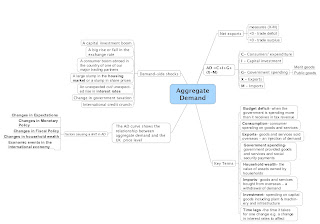
Aggregate Supply

p.s. thanx,Dima, for mindmanager license key)
Aggregate Demand

Aggregate Supply

p.s. thanx,Dima, for mindmanager license key)
Saturday, 18 October 2008
negative externalities ( obesity and smoking)
Today I'm going to talk about two examples of negative externalities, which are, actually, the most wide-spread ones.
1. Obesity
You may think that if people suffer from obesity - it's their own life.
So why is it considered as a negative externality?
In fact, obesity now became a serious problem not only for people themselves, but for the whole nation.
According to BBC News, in England almost two-thirds of adults and a third of children are either overweight or obese.
It has a great impact on social services, for instance, government has to invest money in reconstructing school gyms and canteens, so that it is suitable for overweight people.
And, of course, that affect taxpayers, which are to cover the costs of all these government actions.
What are the ways of reduction people's obesity? It is obvious: advretising heathy products and healthy lifestyle, government subsidies for healthy goods producers in order to make the price for this goods lower than the price for high fat goods.
2. Smoking
'Smoking kills' - that is what is written on each pack of сigarettes. Government is also going to take some actions aganist smoking such as:
1. Banning tobacco vending machines
2. Restricting the display of tobacco products in shops ( which is already done in Canada, but didn't affect the consumption of cigarettes).
3. Add an 'anti-smoking' picture (for example, a photography of smoker's lungs) to each pack of cigarettes.
But will that really stop people from smoking?
I guess it will reduce cigarette consumption to some extent, but won't solve the problem entirely.
However, the cost of cigarette pack may have an influence on people smoking, especially young people.
Let's compare Russia, where a cigarette pack costs no more than 2 dollars, and UK, with 10 dollars for a pack.
60% of men and 30% women smoke in Russia aganist 26% and 23% in UK.
But , on the other hand, that it is not only high prices that affect tobacco consumption, but also national habits and the way children are brought up in both countries.
Talking about impact on people's material life - the situation is similar to the first one (obesity) - tax paid by people is about 9bn pounds each year - a substantial amount of money!
1. Obesity
You may think that if people suffer from obesity - it's their own life.
So why is it considered as a negative externality?
In fact, obesity now became a serious problem not only for people themselves, but for the whole nation.
According to BBC News, in England almost two-thirds of adults and a third of children are either overweight or obese.
It has a great impact on social services, for instance, government has to invest money in reconstructing school gyms and canteens, so that it is suitable for overweight people.
And, of course, that affect taxpayers, which are to cover the costs of all these government actions.
What are the ways of reduction people's obesity? It is obvious: advretising heathy products and healthy lifestyle, government subsidies for healthy goods producers in order to make the price for this goods lower than the price for high fat goods.
2. Smoking
'Smoking kills' - that is what is written on each pack of сigarettes. Government is also going to take some actions aganist smoking such as:
1. Banning tobacco vending machines
2. Restricting the display of tobacco products in shops ( which is already done in Canada, but didn't affect the consumption of cigarettes).
3. Add an 'anti-smoking' picture (for example, a photography of smoker's lungs) to each pack of cigarettes.
But will that really stop people from smoking?
I guess it will reduce cigarette consumption to some extent, but won't solve the problem entirely.
However, the cost of cigarette pack may have an influence on people smoking, especially young people.
Let's compare Russia, where a cigarette pack costs no more than 2 dollars, and UK, with 10 dollars for a pack.
60% of men and 30% women smoke in Russia aganist 26% and 23% in UK.
But , on the other hand, that it is not only high prices that affect tobacco consumption, but also national habits and the way children are brought up in both countries.
Talking about impact on people's material life - the situation is similar to the first one (obesity) - tax paid by people is about 9bn pounds each year - a substantial amount of money!
Thursday, 16 October 2008
book review

As the MindManager doesn't work I used the time to finish my book.
'Discover your inner economist' by Tyler Cowen.
We are used to think that economics is all about graphics, diagrams, difficult calculations - but it isn't. Economics doesn't end with forecasting stock prices - it may be applied and it is applied in our daily life.
That is what this book tells us about - how to deal with our everyday problems using our economic knowledge.
Tyler Cowen explains how people's behaviour is affected by economic principles: the dirty dishes parable, the car salesman parable, the parking tickets parable - let's take the first one as an example.
If parents want to make his child do the dishes, they may consider paying him money for doing housework as a good idea.
And many of them really beleive it works, but, however effective it seems to them, it doesn't.
That is simply because the child takes status of working for the parents as immature or even humiliating.
Another bad point is that the child doesn't put an effort in doing his work properly - because he is paid for that anyway.
So probably the only way to make a child happy to do the washing up is to let him know how important it is for the family and how highly the parents appreciate his ability and willigness to help. This tactic may seem simple, but it unexpectedly does a good job.
That is only an example of what this book is about -you will find a lot more about incentives, penalties and rewards and the impact these have on our life.
You can even find out ( and I did) that you use some of this methods yourself (but never thought about it).
The advantage is that the book is written in plain language with the examples provided for each new topic, - it's like the author has a friendly conversation with a reader ).
In conclusion, I'd like to say that I enjoyed reading this book ( not just because I HAVE TO enjoy it and write a positive review :) ) and I'd advise to read it anybody who wants to get familiar with a different application of economic science.
P.S. In fact, I like reading, but I'm too lazy to do it unless I'm forced to, so, thank you, Chris ))
things to do
Tuesday, 14 October 2008
some key points of the yesterday's philosophy class
The main topic of Monday class was 'The awareness'.
another view on this topic:
http://everything2.com/index.pl?node_id=589307
We consider ourselves being awake, but are we really awake?
That's the question.
There are 5 levels of awareness:
1. Deep sleep state ( we can't even dream in this state )
2. Dream state
3. Sleep-waking state (my usual state)
4. Waking state
5. High consciousness
To move from state#3 to state#4 there is a useful exercise.
You should concentrate on all your senses. Feel the clothes touch your skin, listen to the sounds outside, feel your feet on the ground. That is how you come to presence.
another view on this topic:
following the David's example..

#11 Clean my shoes ))))
#12 Send an e-mail
#13 seems to be unreachable...
not 750 words but anyway
A short beginner’s guide to the credit crunch causes.
If you are still alive, you have probably heard about the world credit crisis, which also had a great impact on the whole economy. But let us start from the beginning....
The origins of the current credit crisis lie back in 2007, when the subprime mortgage crisis took place.
In order to avoid the economy moving into recession, the US government cut interest rates down to 1%, but with a plan to increase this rate slowly by the amount of 0.25% each year approximately.
Therefore, many people started to take ARM’s - adjusted rate mortgages, in other words, mortgages with NOT constant interest rates.
But what happened later: when the loans went back to the normal monthly price, it became unaffordable for many people to pay their mortgages back.
That couldn’t have created such a big problem unless another important factor - house prices - had played a great role in widening this crisis.
Normally the banks would cover their losses by selling the houses, but as the house prices went down, banks faced great losses and, as a result, the lack of liquidity.
Banks found it hard to borrow money from the wholesale markets and even to lend to each
other, which caused the global credit freeze.
That crisis affected the banks all over the world and for some of them ( Nothern Rock was the first) the nationalisation was inevitable.
Another important action taken by government was a bail-out of 700bn of pounds to buy ‘toxic’ assets from the banks.
That all illustrates the main events and the basic points of the credit crunch.
But it is still not over...
If you are still alive, you have probably heard about the world credit crisis, which also had a great impact on the whole economy. But let us start from the beginning....
The origins of the current credit crisis lie back in 2007, when the subprime mortgage crisis took place.
In order to avoid the economy moving into recession, the US government cut interest rates down to 1%, but with a plan to increase this rate slowly by the amount of 0.25% each year approximately.
Therefore, many people started to take ARM’s - adjusted rate mortgages, in other words, mortgages with NOT constant interest rates.
But what happened later: when the loans went back to the normal monthly price, it became unaffordable for many people to pay their mortgages back.
That couldn’t have created such a big problem unless another important factor - house prices - had played a great role in widening this crisis.
Normally the banks would cover their losses by selling the houses, but as the house prices went down, banks faced great losses and, as a result, the lack of liquidity.
Banks found it hard to borrow money from the wholesale markets and even to lend to each
other, which caused the global credit freeze.
That crisis affected the banks all over the world and for some of them ( Nothern Rock was the first) the nationalisation was inevitable.
Another important action taken by government was a bail-out of 700bn of pounds to buy ‘toxic’ assets from the banks.
That all illustrates the main events and the basic points of the credit crunch.
But it is still not over...
Monday, 13 October 2008
just a quick note
The law of diminishing returns.
More and more hours I 'invest' in writing the book, less and less productive I am....
Subscribe to:
Posts (Atom)


